




From young innovators to happy aged care residents: Weaving together art and science with a splash of creativity
In 2025, Cerulean Space collaborated with Newmark Primary School and Aeralife Aged Care to deliver innovative and meaningful inventions to support the mental wellbeing of aged care residents. This brief article provides an overview of this heartwarming and inspiring project.
A discussion about art therapy and neuroscience
Newmark is a Melbourne-based primary school that focuses on developing children’s capacity to contribute to the community in meaningful ways. As part of Newmark’s curriculum on neuroplasticity, Cerulean Space Art Therapy was invited to explore the connection between art therapy and neuroscience with the Grade 2-3 students. Cerulean Space offered a real-world perspective on what art therapy is; the neuroscience behind the discipline; and a focused discussion on using art therapy to support older adults living in aged care.

From concept to execution
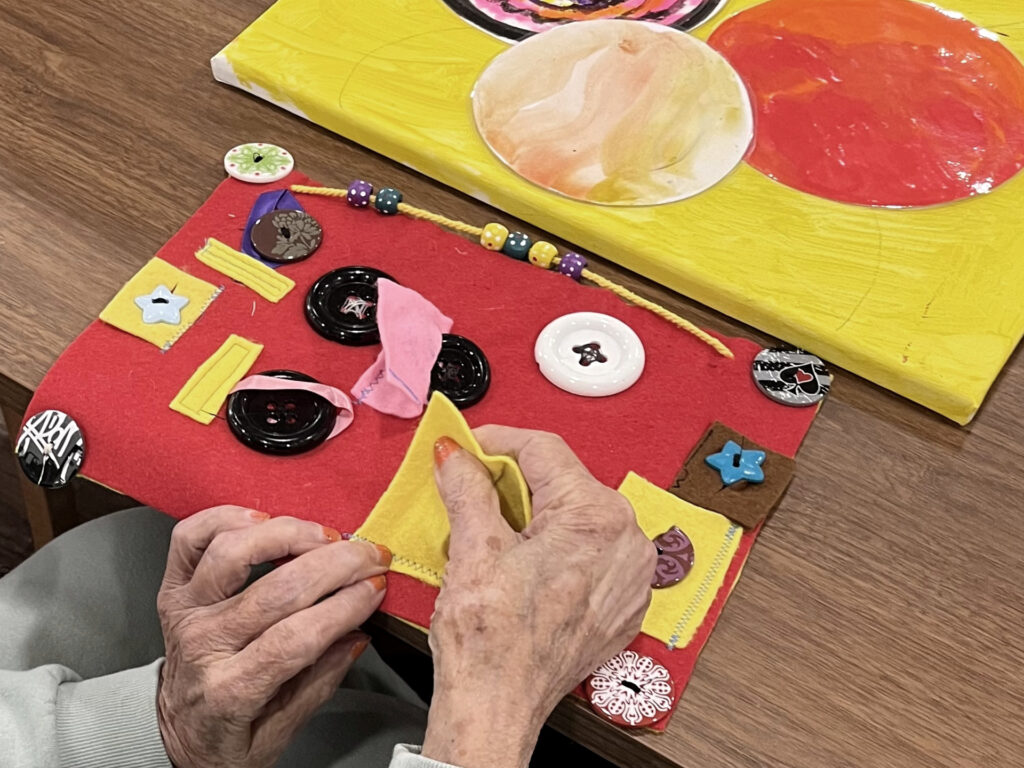
The future innovators from Newmark created a range of products for art therapists to use when working with older adults. Adopting a Design Thinking approach, the students created product prototypes taking into account their theoretical knowledge about neuroplasticity, the target audience (art therapists working with older adults), and the implementation context (residential aged care). During the prototype presentation, the students shared their innovation journey, design principles, roadblocks and challenges, and final outcomes (e.g. fidget board, mystery box).
Cerulean Space then had the honour to integrate these innovations into a group art therapy session for the memory unit residents from Aeralife Watergarden. The creative products enabled the participants to utilise their fine motor skills, stimulated their visual and haptic senses, prompted reminiscence and memory recalls, fostered social connection, and facilitated creative expressions. Some participants indicated that they “really liked it”; and others, while unable to verbalise, maintained prolonged engagement with the various activities.
Art therapy supporting older adults’ wellbeing
Art therapy is an evidence-based mental health profession that fosters holistic wellbeing through art making and material interaction. Art therapy sessions are facilitated by qualified art therapists whose roles are to support, facilitate, contain, witness and co-regulate. Beyond the therapeutic value from art making, art therapy’s mechanisms of change are also grounded in neuroscience and interpersonal neurobiology. For older adults in particular, research has found that art therapy can improve self-esteem, mood, self-expression, cognitive skills, fine motor skills, social connection, and overall Quality of Life.1
Art therapy in residential aged care
In light of the ageing population in Australia, more and more aged care facilities such as Aeralife are incorporating art therapy into their lifestyle programs to support the wellbeing of their residents. Cerulean Space was extremely honoured and inspired to work with the students and teachers from Newmark, and the staff and residents from Aeralife on this innovative, person-centred and heart-warming project.
If you are curious about how art therapy can be integrated into your residential aged care’s lifestyle and wellbeing programs, please contact us. Cerulean Space offer one-off, ongoing, and targeted programs designed to support the needs of the participants.
Footnotes
- Alders, A., & Levine-Madori, L. (2010). The effect of art therapy on cognitive performance of Hispanic/Latino older adults. Art Therapy, 27(3), 127–135. https://doi.org/10.1080/07421656.2010.10129661
Ciasca, E. C., Ferreira, R. C., Santana, C. L. A., Forlenza, O. V., Dos Santos, G. D., Brum, P. S., & Nunes, P. V. (2018). Art therapy as an adjuvant treatment for depression in elderly women: a randomized controlled trial. Revista Brasileira de Psiquiatria, 40(3), 256–263. https://doi.org/10.1590/1516-4446-2017-2250
Chauhan, S. (2020). Dementia and sculpture-making: Exploring artistic responses of people with dementia. Dementia, 19(2), 416–432. https://doi.org/10.1177/1471301218777446
Kim, H. K., Kim, K. M., & Nomura, S. (2016). The effect of group art therapy on older Korean adults with Neurocognitive Disorders. The Arts in Psychotherapy, 47, 48–54. https://doi.org/10.1016/j.aip.2015.11.002
Pike, A. A. (2013). The effect of art therapy on cognitive performance among ethnically diverse older adults. Art Therapy, 30(4), 159–168. https://doi.org/10.1080/07421656.2014.847049
Stephenson, R. C. (2013). Promoting well-being and gerotranscendence in an art therapy program for older adults. Art Therapy, 30(4), 151–158. https://doi.org/10.1080/07421656.2014.846206
Tietyen, A. C., & Richards, A. G. (2020). A Visual Arts Education pedagogical approach for enhancing quality of life for persons with dementia (innovative practice). Dementia, 19(4), 1244–1251. https://doi.org/10.1177/1471301217726612
Windle, G., Joling, K. J., Howson-Griffiths, T., Woods, B., Jones, C. H., van de Ven, P. M., Newman, A., & Parkinson, C. (2018). The impact of a visual arts program on quality of life, communication, and well-being of people living with dementia: a mixed-methods longitudinal investigation. International Psychogeriatrics, 30(3), 409–423. https://doi.org/10.1017/S1041610217002162 ↩︎