Talk Therapy Didn’t Work for Me
If you’ve tried talk therapy and felt nothing shifted, it’s likely the approach didn’t match how your body is holding what’s there. This article is about what else exists, and how creative art therapy can reach what words can’t.
In this article
- Why some things never come out in words
- Differences between talk therapy and art therapy
- Talk therapy vs art therapy – which is better?
- How you might know this is for you
If you’re here because traditional talk therapy didn’t work for you, the first thing to understand is that this is perfectly normal. Maybe you’ve sat through many talk therapy sessions. You described what was bothering you, you could trace it back to your childhood, your parents, your other relationships, and to all of the things that are happening or have happened in your life.
And yet despite following the process and sticking to the program, you still don’t feel better, or feel like you haven’t made much progress. Maybe you left the session feeling articulate but unchanged, or perhaps even worse than you did at the start of the session. You weren’t doing it wrong. Sometimes we need more than words to help us process and unpack deeper feelings or struggles. To understand how art therapy can help you where talk therapy didn’t work, read on.

Some things don’t come out in words
Here’s something to consider as you reflect on your journey with therapy: not everything that affects people is stored in the part of the brain that thinks and processes language.
The thinking part of the brain is called the prefrontal cortex. It is responsible for rational thinking, planning, decision-making, self-control, and weighing the consequences of actions. It came online relatively recently in human evolution.
The feeling and survival parts of the brain, the limbic system and brainstem, are much older. They don’t rely on words or rational thoughts, instead they involve emotions, implicit memories, instincts, and motor impulses. Implicit memories can be stored in our nervous systems without our conscious awareness. This is especially true from experiences that occurred earlier in life, from periods that were overwhelming, and from those times when it didn’t feel safe to feel. These memories can be encoded as fragmented sensory impressions, emotions, physical sensations or images, making them difficult to articulate. As such, people sometimes struggle to verbalise in therapeutic settings because the memories and experiences they are drawing on are not always stored as coherent narratives.
When discussing traumatic events, people often experience feelings of shame, fear, guilt, and vulnerability, which can re-trigger fight-flight-freeze responses as a way of self-protection or survival. This can in turn active the stress response system, reducing the ability to access language, organised thinking and memories.
Consequently, even in a therapeutic setting, trauma survivors often struggle to articulate what happened. This is not because they don’t want to, but because they are unable to.
So when you sit across from your therapist and try to explain what’s wrong, you might be doing exactly what you’re being asked to do, but somehow this completely misses what needs attention. It’s a shortcoming of being limited to a particular approach.
Talk based therapies are powerful in many ways, but in some circumstances, they can be like trying to understand a book by describing the cover. If this resonates with you, art therapy could be an alternate option.

Talk therapy versus art therapy
Talk therapy provides a space for reflection, insight, and creating meaning through language. They help individuals explore thoughts, emotions, and relationships. Talk therapy relies verbal communication, cognitive processing, and explicit memories (i.e. conscious recollection of facts and events).
Art therapy, by contrast, enables expression through non-verbal means, which can be particularly valuable when feelings or experiences are difficult to articulate. Use of images, symbols, colours, and creative processes can enable individuals to access emotions and memories that are not yet available to conscious verbal reflection.
Talk therapy (e.g. Cognitive Behavioural Therapy (CBT), counselling) typically adopts a “top-down approach”, which targets thoughts, beliefs, explicit memories, and the mental patterns that create meaning in lived experiences. They help individuals understand and reframe their experiences. They’re excellent when the thinking layer is where the issues live, and when the nervous system feels safe enough to articulate what’s happening.
In contrast, a “bottom-up” therapeutic approach focuses on fostering a felt sense of safety and regulating the nervous system before making meaning or rationalising anything. Such therapeutic approach often involves rhythmic movement, sensory engagement and relational safety to achieve embodied experiences.
Art therapy is uniquely positioned where the therapist can seamlessly select a bottom-up and/or a top-down approach to support the need of a client in the moment. For example, an art therapist may offer an invitation to a client during a session, where one can represent their thoughts and feelings through art. Conversely, the focus of a session may also be on the engagement with the art material and the meaning making can come later. In particular, sensorimotor art therapy, such as Clay Field Therapy and Guided Drawing (Bilateral Drawing), combines principles from somatic experiencing, art therapy and neuroscience, to foster embodied healing through rhythmic movement, sensory inputs, motor impulses and relational safety.
Talk therapy versus art therapy – which is better?
There is no one size fits all solution to therapy. Neither talk therapy nor art therapy can be considered inherently better than the other. The effectiveness of any therapeutic approach depends on factors such as the individual’s therapeutic goals and needs, mental and physical health conditions, social and relational circumstances, and protective factors and support network.
In fact, talk therapy and art therapy can sometimes be complementary. When used together, art therapy can deepen and enrich the therapeutic work undertaken in talk therapy, while talk therapy can help individuals make sense of and integrate the insights that emerge through creative expression, supporting a more holistic approach to healing and self-awareness.
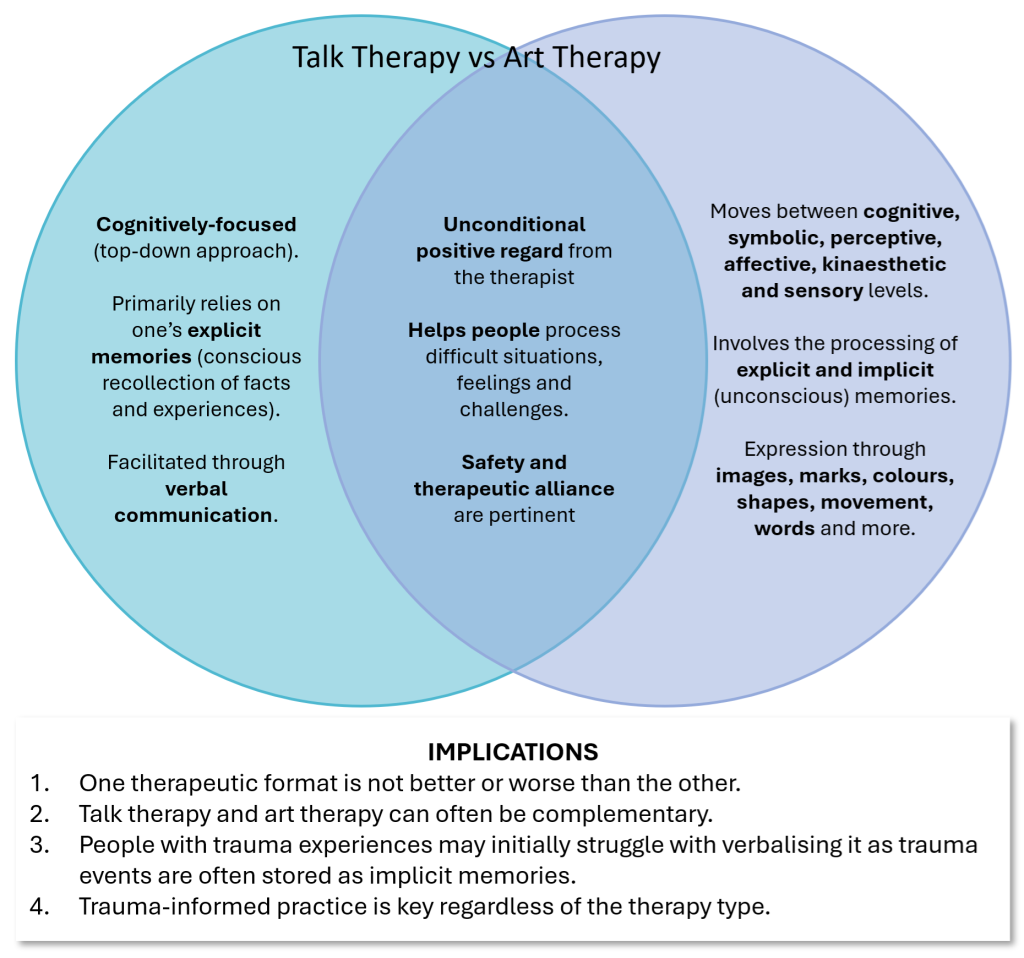
Regardless of your therapeutic preference, person-centred and trauma-informed principles must underpin any therapeutic practices. Your therapist’s role is to provide you with unconditional positive regard, foster safety and trust, and support you on your therapy journey.
How you might know this is for you
If any of this is resonating with you and you are curious about how art therapy might work for you, we can have a free 15-minute conversation, by phone or video, to see if art therapy may be right for you. No further commitment is necessary.
You don’t need to have all the answers. You don’t need to be good at art, or to have done anything like this before. You just need to be ready to explore something different to that which didn’t work last time.