
Art Therapy and Trauma Healing
Kanling Juric
Art Therapist & Founder
Read Time: 9 minutes
17 August 2026
Perhaps you’ve been through something traumatic and no longer feel like yourself; or that you often experience numbness, disconnection, and discomfort being in your own body but can’t explain why. It’s important to recognise that what you are experiencing is not your fault and there is nothing wrong with you. It’s about “what happened to you”.1 This article explores what trauma is and how art therapy can support trauma healing. And no, art therapy is not the same as using colouring books for distraction. Art therapy is an evidence-based mental health profession facilitated by a qualified and registered Art Therapist to foster holistic healing.
In this article
- What is trauma?
- Art and how we process information
- Art media properties and creative healing
- Conclusion
What is trauma?
Trauma occurs when (a) single or multiple incident(s) severely impact(s) one’s nervous system, resulting in emotional dysregulation.2 The Diagnostic and Statistical Manual of Mental Disorders3 identifies several trauma and stress-related disorders such as Post-Traumatic Stress Disorder (PTSD). Key diagnostic features of PTSD include the experiencing or witnessing of traumatic incident(s), coupled with presentations such as persistent distressing memories, cognitive and affective impairment, and trigger avoidance behaviours, for at least one month.4 The International Classification of Diseases further identifies Complex PTSD, developed from sustained exposure to traumatic events.5 Trauma adversely impacts one’s emotional regulation and psychological wellbeing.6
Trauma survivors are affected by the neurological patterns formed during the traumatic events, where their stress response systems were overstimulated.7 Their fight-or-flight responses can be easily triggered by present stressors such as a scent or a sound,8 often making them feel like the threat is happening in the here and now. Trauma memories are stored as implicit memories which are difficult to access verbally.9 Traumatic experiences can inhibit brain hemispheres’ integration, and dysregulate the limbic system which is responsible for emotional regulation.10
Art and how we process information
Art therapy is a holistic approach that works with both the body and mind. It recognises that trauma affects not only thoughts and emotions, but also physical sensations and movement. Because traumatic experiences can be difficult to put into words, art therapy offers a non-verbal way for people to explore, express, and process their memories and experiences.11

One of the most widely used frameworks in art therapy is the Expressive Therapies Continuum (ETC). Developed by Kagin and Lusebrink,12 and extended by Lusebrink,13 and Hinz,14 the ETC helps to explain how people process information and express themselves through creativity. A central idea of the ETC is that the way people interact with art materials can reflect how they think, feel, and respond to challenges. This makes the framework useful not only for understanding a person’s experiences, but also for guiding therapeutic interventions.15 The ETC helps art therapists choose materials and activities that match a person’s needs, strengths, and preferred ways of processing information. The ETC describes three main levels of processing intersecting with the Creative level:
- Kinaesthetic and Sensory: engaging through movement, touch, and sensory experiences.
- Perceptual and Affective: working with visual elements, images, and emotional expression.
- Cognitive and Symbolic: using problem-solving, reflection, personal meaning, and symbolic thinking.
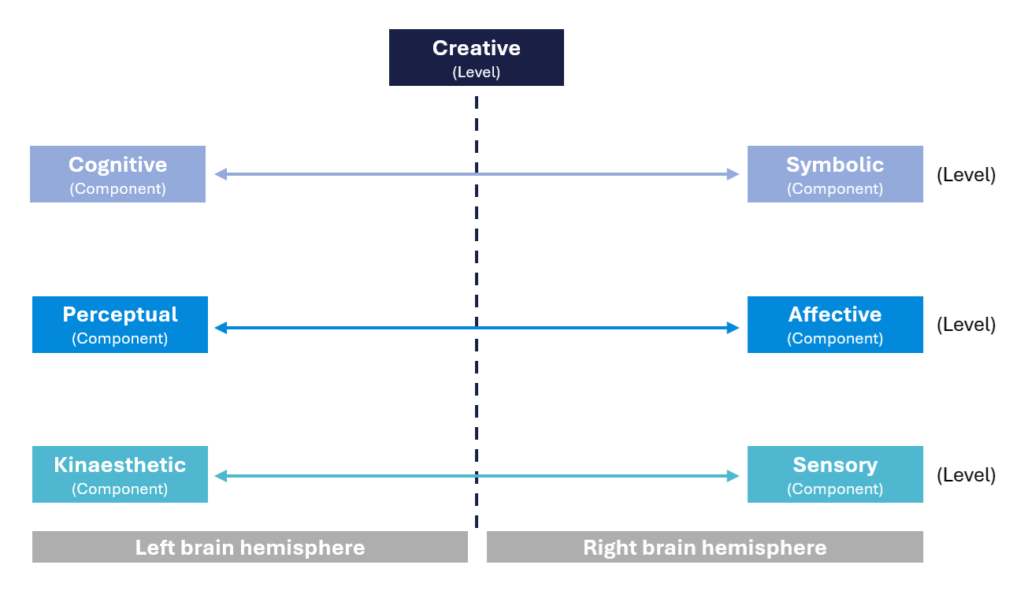
Adapted from “Expressive Therapies Continuum: Use and value demonstrated with case study”.16 Copyright 2015 by Routledge.
The model also recognises that different ways of making art engage different brain functions. The left-brain hemisphere is more connected to language, logic, and analysis, while the right is linked to visuospatial processing, creativity, and emotional regulation. The overall aim is to support balance and integration across these different ways of experiencing and understanding the world.17
In trauma recovery, art therapy aims to help individuals connect sensory experiences, emotions, thoughts, and personal meaning into a more integrated whole. This process can support the integration of traumatic memories, which is an important goal in trauma treatment.18 Through structured engagement with art materials, trauma survivors can build on their strengths, develop greater self-awareness, and gradually move toward healing and integration.
Kinaesthetic / Sensory
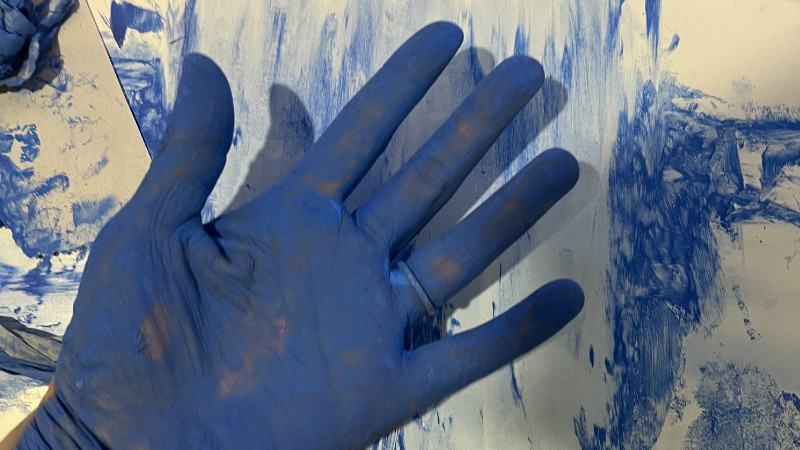
The kinaesthetic / sensory level can enable tension release, facilitate non-verbal memory recall, enrich sensory engagements, and synchronise bodily rhythms.19 The haptic perception can foster security and improve emotion regulation by activating the interconnection between the sensorimotor system and the limbic system.20 For instance, trauma treatment using clay allows the one to relax (e.g. muscular movement from kneading), become more physically attuned (e.g. rhythmic pinching), and immerse in the sensory experience.21 Haptic sensations can also increase one’s capacity to be present, which is another trauma treatment goal.22 The ETC aligns with the staged approach to trauma treatment. The kinaesthetic/sensory level supports the initial objectives of establishing trust, safety, and hope;23 and controlling symptoms.24 Studies demonstrated kinaesthetic / sensory-focused activities’ efficacy in treating traumatised children,25 and improving adults’ emotional regulation.26
Perceptual / Affective
The interplay between the affective and perceptual components enables individuals to achieve balance between expression and containment.27 The subsequent treatment phase aims to encourage contained emotional exploration;28 and facilitate memory recall.29 For example, traumatic memories were visualised through painting and drawing among PTSD clients;30 emotions were explored by applying colours within body outlines;31 and masks were used to help PTSD veterans to externalise feelings.32 Moreover, the perceptual elements help to contain the externalised content through imposing limits such as the parameter of masks,33 and body outlines.34 Visual elements (e.g. lines, forms) can further assist individuals to organise chaotic thoughts and re-gain control,35 which can benefit trauma survivors who are affected by involuntary neurological reactions.
Cognitive / Symbolic
The cognitive / symbolic level provides the foundation for rewriting narratives and developing coping skills.36 The brain’s neuroplasticity enables neurological pathways to be re-wired.37 This ETC level aligns with the trauma treatment stage that focuses on re-establishing meaning, and reorganising and reconstructing narratives.38 For instance, earlier artworks created were re-ordered and transformed into new artworks;39 and participants drew new body outlines after various sessions and reported reduced negative affect.40 These examples demonstrate the use of cognitive capacity (e.g. problem solving, stepwise planning) and symbolic functioning (e.g. assigning meanings) to achieve transformation.
Putting it all together: The creative level
The creative level of the framework is characterised by the balanced functioning of ETC components, the integration between brain hemispheres, and the emergence of insights.41 This level supports treatment goals relating to “integration”, “healing”, and “maintenance”.42 Trauma survivors may establish greater mental cohesion;43 develop resilience;44 and foster post-traumatic growth through finding flow.45
Art therapy is a strength-based therapeutic approach;46 and the ETC helps to systematically identify the clients’ strengths and needs in the context of their trauma recovery progress. An art therapist would tailor sessions and materials to facilitate seamless movement between levels to support a client’s therapeutic needs. for example, moving from kinaesthetic / sensory to perceptual / affective to increase trauma memory processing; or moving between perceptual and affective components to promote safe exploration.47 The ETC is an adaptable model that supports the staged approach of trauma treatment.

Art media properties and creative healing
Art media properties can facilitate, enhance, or inhibit one’s creative expression and impact the art making experience.48 Kagin and Lusebrink’s49 media properties scale or Media Dimension Variables (MDV) provides a conceptual model to systematically deconstruct the dynamic interactions between the art making activity and materials, comprising:
- task structure,
- complexity, and
- physical properties (fluid/resistive).
Art therapists consider the MDV in conjunction with the ETC to inform trauma interventions.
Physical Properties
Resistive and fluid media can be used at different trauma treatment stages driven by the relevant treatment goals. Activities such as collage making and drawing utilises controlled media can be suitable to establish safety and reduce anxiety;50 while fluid media such as paint can support the externalisation of memories and emotions (Naff, 2014). Media choices must ensure a balance between control and expression to maintain safety.51
Structure and Complexity
Greater structure and complexity can increase cognitive functioning, whereas less structure promotes affective and symbolic processing.52 Treatment decisions regarding structure and complexity would consider the individual’s dominant organising function; the trauma recovery stage; and therapy length. For instance, if the trauma survivor is cognitively-oriented, providing less structured and lower complexity tasks may help to elicit emotional expression.53

In terms of treatment stages, providing some structure with lower complexity may support the initial goals of establishing safety and control.54 For example, draw a safe place or colour in mandalas;55 or draw within a body outline.56 During the memory recall stage, less structure may evoke emotional expression. For example, represent a traumatic memory;57 or symbolic expression of trauma.58 At the integration stage which focuses on rewriting narrative and improving coping skills, facilitating cognitive/symbolic processing and creativity may be achieved through greater complexity and less structure. For example, reorder and transform previous artworks to identify insights and new meanings.59
Lastly, shorter treatment programs are often more structured with defined goals and directives. For example, mandala therapy;60 structured art therapy workshops;61 and structured tasks such as mask making.62 Longer term programs can afford more flexibility. For instance, a three-tier treatment was applied to long-term PTSD clients, which progressed from more structured activities to open studio.63
Conclusion
The ETC and MDV provide art therapists with structured frameworks to inform therapeutic treatment decisions and clinical assessments. These conceptual models are versatile and adaptable across different populations. Within a trauma context, the ETC directly supports the body-mind approach. The art therapist is able to consider the neurological impact, in conjunction with one’s information processing tendencies revealed through art making and their interaction with materials. Clients are encouraged and supported to move across the different ETC levels, facilitated by varying MDV combinations in line with their needs and treatment progress, which ultimately helps them achieve integration and balanced functioning. Finally, these conceptual models are not applied in a prescriptive manner. A person-centred approach underpins any practical application to support the therapeutic needs and outcomes of the client.
Footnotes
- Perry, B. D., & Winfrey, O. (2021). What happened to you?: Conversations on trauma, resilience, and healing. Flatiron Books. ↩︎
- Backos, A. (2021). Post-traumatic stress disorder and art therapy. Jessica Kingsley Publishers; Elbrecht, C., & Antcliff, L. R. (2014). Being touched through touch. Trauma treatment through haptic perception at the Clay Field: A sensorimotor art therapy. International Journal of Art Therapy, 19(1), 19-30. https://doi.org/10.1080/17454832.2014.880932 ↩︎
- American Psychiatric Association. (2013). Diagnostic and statistical manual of mental disorders (5th ed.). https://doi.org/10.1176/appi.books.9780890425596 ↩︎
- Ibid. ↩︎
- World Health Organisation. (2021). International Statistical Classification of Diseases and Related Health Problems (ICD-11). https://www.who.int/standards/classifications/classification-of-diseases ↩︎
- Belkofer, C. M. & Nolan, E. (2016). Practical applications of neuroscience in art therapy: A holistic approach to treating trauma in children. In J. L. King (Ed.), Art therapy, trauma, and neuroscience: Theoretical and practical perspectives (pp. 157-172). Taylor & Francis Group; Lusebrink, V. B. & Hinz, L. D. (2016). The Expressive Therapies Continuum as a framework in the treatment of trauma. In J. L. King (Ed.), Art therapy, trauma, and neuroscience: Theoretical and practical perspectives (pp. 42-66). Taylor & Francis Group. ↩︎
- Lusebrink & Hinz, 2016 ↩︎
- Tripp, T. (2016). A body-based bilateral art protocol, for reprocessing trauma. In J. L. King (Ed.), Art therapy, trauma, and neuroscience: Theoretical and practical perspectives (pp. 173-194). Taylor & Francis Group; Van de Kolk, B. (2014). The body keeps the score: Brain, mind and body in the healing of trauma. Penguin Books. ↩︎
- Gantt, L. & Greenstone, L. (2016). Narrative art therapy in trauma treatment. In J. A. Rubin (Ed.), Approaches to art therapy: theory and technique (3rd ed., pp. 353-370). Routledge; Tripp, 2016 ↩︎
- Lusebrink & Hinz, 2016; Van de Kolk, 2014 ↩︎
- Akthar, Z., & Lovell, A. (2019). Art therapy with refugee children: a qualitative study explored through the lens of art therapists and their experiences. International Journal of Art Therapy, 24(3), 139-148. https://doi.org/10.1080/17454832.2018.1533571; Tripp, 2016 ↩︎
- Kagin and Lusebrink, 1978 ↩︎
- Lusebrink, V. B. (1990). Imagery and visual expression in therapy. Plenum Press; Lusebrink, V. B. (1991). A systems oriented approach to the expressive therapies: The expressive therapies continuum. The Arts in Psychotherapy, 18(5), 395-403. https://doi.org/10.1016/0197-4556(91)90051-B; Lusebrink, V. B. (2004). Art therapy and the brain: An attempt to understand the underlying processes of art expression in therapy. Art Therapy, 21(3), 125-135. https://doi.org/10.1080/07421656.2004.10129496 ↩︎
- Hinz, L. D. (2009/2020). Expressive therapies continuum: a framework for using art in therapy (2nd ed.). Routledge. ↩︎
- Lusebrink, V. B. (2010). Assessment and therapeutic application of the Expressive Therapies Continuum: Implications for brain structures and functions. Art Therapy, 27(4), 168-177. https://doi.org/10.1080/07421656.2010.10129380 ↩︎
- Hinz, L. D. (2015). Expressive Therapies Continuum: Use and value demonstrated with case study Canadian Art Therapy Association Journal, 28(1-2), 43-50; Canadian Art Therapy Association Journal, 28(1-2), p.46. https://doi.org/10.108/0/08322473.215.1100581. ↩︎
- Hinz, 2009/2020; Lusebrink & Hinz, 2016 ↩︎
- Gantt & Greenstone, 2016; Lusebrink & Hinz, 2016 ↩︎
- Elbrecht, C. (2013). Trauma healing at the clay field: A sensorimotor art therapy approach. Jessica Kingsley Publishers; Hinz, 2009/2020 ↩︎
- Elbrecht & Antcliff, 2014; Elbrecht, C., & Antcliff, L. (2015). Being in touch: Healing developmental and attachment trauma at the Clay Field. Children Australia, 40(3), 209-220. https://doi.org/10.1017/cha.2015.30 ↩︎
- Ibid. ↩︎
- Elbrecht & Antcliff, 2014; Van de Kolk, 2014 ↩︎
- Backos, 2021, Naff, K. (2014). A framework for treating cumulative trauma with art therapy. Art Therapy, 31(2), 79-86. https://doi.org/10.1080/07421656.2014.903824 ↩︎
- Schouten, K., van Hooren, S., Knipscheer, J., Kleber, R., & Hutschemaekers, G. J. (2019). Trauma-focused art therapy in the treatment of posttraumatic stress disorder : A pilot study. Journal of Trauma & Dissociation, 20(1), 114-130. https://doi.org/10.1080/15299732.2018.1502712 ↩︎
- Elbrecht & Antcliff, 2014; Lusebrink & Hinz, 2016 ↩︎
- Nan, J. K. M., Hinz, L. D., & Lusebrink, V. B. (2021). Clay art therapy on emotion regulation: Research, theoretical underpinnings, and treatment mechanisms. In C. R. Martin, V. B. Patel, L. Hunter, & V. R. Preedy (Eds.), The neuroscience of depression (pp. 431-442). Elsevier Inc. https://doi.org/10.1016/C2018-0-01715-6 ↩︎
- Lusebrink & Hinz, 2016 ↩︎
- Naff, 2014 ↩︎
- Backos, 2021; Schouten et al., 2019 ↩︎
- Schouten et al., 2019 ↩︎
- Luzzatto, P., Ndagabwene, A., Fugusa, E., Kimathy, G., Lema, I., & Likindikoki, S. (2021). Trauma Treatment through Art Therapy (TT-AT): a ‘women and trauma’ group in Tanzania. International Journal of Art Therapy. https://doi.org/10.1080/17454832.2021.1957958 ↩︎
- Jones, J. P., Walker, M. S., Drass, J. M., & Kaimal, G. (2018). Art therapy interventions for active duty military service members with post-traumatic stress disorder and traumatic brain injury. International Journal of Art Therapy, 23(2), 70-85. https://doi.org/10.1080/17454832.2017.1388263 ↩︎
- Ibid. ↩︎
- Luzzatto et al., 2021 ↩︎
- Nan et al., 2021 ↩︎
- Gantt & Greenstone, 2016; Lusebrink & Hinz, 2016 ↩︎
- Belkofer & Nolan, 2016; Van de Kolk, 2014 ↩︎
- Backos, 2021; Naff, 2014; Schouten et al., 2019 ↩︎
- Schouten et al., 2019 ↩︎
- Luzzatto et al., 2021 ↩︎
- Hinz, 2009/2020; Lusebrink and Hinz, 2016 ↩︎
- Backos, 2021, p.67; Naff, 2014, p.85; Schouten et al., 2019 ↩︎
- Schouten et al., 2019 ↩︎
- Backos, 2021 ↩︎
- Csikszentmihalyi, M. (1997). Finding flow. Basic Books; Lusebrink & Hinz, 2016 ↩︎
- Rowe, C., Watson-Ormond, R., English, L., Rubesin, H., Marshall, A., Linton, K., Amolegbe, A., Agnew-Brune, C., & Eng, E. (2017). Evaluating art therapy to heal the effects of trauma among refugee youth. Health Promotion Practice, 18(1), 26 33. https://doi.org/10.1177/1524839915626413 ↩︎
- Lusebrink & Hinz, 2016 ↩︎
- Graves-Alcorn, S, and Kagin, C. (2017). Implementing the Expressive Therapies Continuum: A guide for clinical practice. Taylor & Francis Group. ↩︎
- Kagin, S. & Lusebrink, V. B. (1978). The Expressive Therapies Continuum. Art Psychotherapy, 5, 171-180. https://doi.org/10.1080/17454832.2012.713370 ↩︎
- Schouter et al., 2019 ↩︎
- Naff, 2014 ↩︎
- Hinz, 2009/2020 ↩︎
- Lusebrink & Hinz, 2016 ↩︎
- Backos, 2021 ↩︎
- Schouten, K., Niet, G. J. D., Knipscheer, J., Kleber, R., & Hutschemaekers, G. J. (2015). The effectiveness of art therapy in the treatment of traumatized adults. Trauma, Violence & Abuse, 16(2), 220-228. https://doi.org/10.1177/1524838014555032; Schouten et al., 2019 ↩︎
- Luzzatto et al., 2021 ↩︎
- Schouten et al., 2019 ↩︎
- Luzzatto et al., 2021 ↩︎
- Luzzatto et al., 2021; Schouten et al., 2019 ↩︎
- Schouten et al., 2015 ↩︎
- Luzatto et al., 2021 ↩︎
- Jones et al., 2018 ↩︎
- Ibid. ↩︎